When comparing NEUBIE vs TENS, anyone who has ever stepped into a physical therapy clinic or dealt with chronic muscle pain, you’re probably familiar with those little “zapping” devices with sticky pads. Most of us know them as TENS (Transcutaneous Electrical Nerve Stimulation) units.
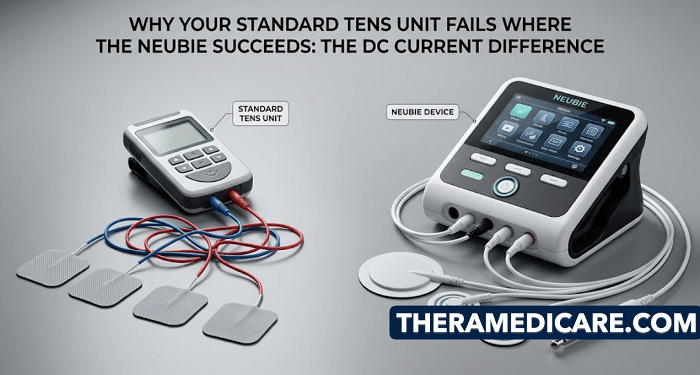
Lately, though, a new technology called the NeuFit NEUBIE has been making waves, claiming to be lightyears ahead when it comes to injury rehab and muscle recovery. The catch? To the untrained eye, they look almost identical. Both stick to your skin, and both send electrical currents into your body.
So, is the NEUBIE just a massively overpriced TENS machine? Or is there real science backing up the hype?
The answer comes down to the actual electricity they use: Alternating Current (AC) vs. Direct Current (DC). Let’s break down the science of NEUBIE vs TENS and see how this simple difference in physics completely changes how your body heals., backed by the latest scientific evidence.
1. TENS Units Use AC Current: Just a Temporary Glitch in Your Pain Alarm
Most traditional electrical stimulation devices on the market—including those cheap, pocket-sized TENS units you can buy online—rely on Alternating Current (AC).
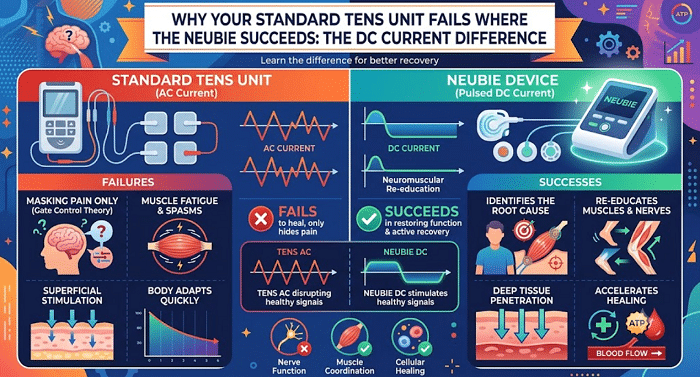
An AC signal constantly flips back and forth, changing directions multiple times a second. Because of this unstable, shifting pattern, AC current can’t penetrate deeply into your central nervous system. It pretty much just hangs out on the surface of your skin, stimulating your sensory nerve fibers.
How TENS Actually Works: TENS operates on what scientists call the Gate Control Theory. The AC current floods your nervous system with a constant “tingling” sensation. This keeps your brain too busy to notice, temporarily blocking the actual pain signals. However, this temporary block is a major factor when evaluating the long-term results of NEUBIE vs TENS.
The Downside: The second you turn the TENS unit off, the pain relief starts to fade. TENS doesn’t fix the root cause of the issue; it just acts like a digital painkiller. On top of that, AC current often forces your muscles to contract defensively. This can leave your muscles exhausted or trigger muscle guarding (where the body locks up the muscle to protect it).
2. The NEUBIE Uses DC Current: Speaking Your Nervous System’s Native Language
On the flip side, the NEUBIE (Neuro-Bio-Electric Stimulator) uses Direct Current (DC) via a uniquely engineered waveform. Unlike AC, DC current flows smoothly in one single direction.
Why does this matter biologically? Because the human body naturally runs on direct current (DC). The signals sent from your brain to your muscles are direct electrical impulses. Since the NEUBIE speaks the exact same electrical language as your body, your nervous system doesn’t treat it like an outside threat.
Here is what the NEUBIE’s DC current can achieve, proving why the core technology behind NEUBIE vs TENS is completely different:
- Neuromuscular Re-Education: Because the current is steady and unidirectional, the NEUBIE penetrates much deeper to reach your motor neurons (the nerves that control movement). When paired with active movement, it retrains your brain on how to turn back on muscles that went “dormant” or locked up after an injury.
- Zero Defensive Fighting: The NEUBIE is designed with a special carrier wave that prevents electrical charges from building up painfully on the skin. This means patients don’t experience harsh, agonizing muscle spasms. Instead, they get strong sensory input while still being able to move freely during therapy.
- Triggering True Tissue Healing: Biologically speaking, direct current has a long history of clinical research showing it boosts macrophage migration, promotes cell regeneration, and increases local blood flow to speed up the healing of damaged tissues.
What the Research Says: Clinical Evidence (NEUBIE vs TENS)
If you want hard data, an open-label comparative study published on PubMed Central (PMC) put Direct Current Neuromuscular E-Stim (like the NEUBIE) head-to-head against traditional TENS on patients suffering from Diabetic Peripheral Neuropathy—a condition causing severe numbness and foot pain from nerve damage.
Here is a quick look at how they compared:
| Measurement Parameter | NEUBIE Group (DC Current) Results | TENS Group (AC Current) Results |
| Pain Reduction (VAS Scale) | Showed a statistically significant drop in pain levels. | No statistically significant change or improvement. |
| Touch Sensitivity & Discrimination | Two-point discrimination improved sharply (nerves regained sensitivity). | Showed no meaningful change in sensitivity. |
| Muscle Motor Unit Activation | Experienced an increase in signal amplitude (muscles recruited more fibers). | No increase in motor unit recruitment. |
| Nerve Conduction Velocity (NCV) | Nerve signal speed increased significantly across most tested nerves. | Showed no difference or speed improvement. |
The Journal’s Takeaway: The study concluded that physical therapy paired with a DC device like the NEUBIE delivers vastly superior objective and subjective improvements compared to conventional TENS. TENS simply fails to create long-term changes in nerve function, which is the most critical takeaway from this NEUBIE vs TENS clinical trial.
The Verdict: Which One Do You Actually Need?
If you’re just looking for a budget-friendly way to take the edge off some mild muscle soreness at home while watching TV, a standard TENS unit might do the trick for a couple of hours.
But if you are trying to heal an injury faster, wake up weak muscles, fix poor movement patterns after a trauma, and completely rewire your central nervous system for long-term recovery, the NeuFit NEUBIE device is what you actually need.
When it comes down to NEUBIE vs TENS, the NEUBIE isn’t just a band-aid for pain—it’s a bio-electric rehab tool built to work with your biology, not against it.
Scientific References & Further Reading
If you want to dive deeper into the clinical data and physics behind this technology, check out these peer-reviewed studies and medical literature:
- Comparative Clinical Trial (DC vs. AC): “Open-Label Comparative Study of Direct Current Neuromuscular Electrical Stimulation versus Transcutaneous Electrical Nerve Stimulation in Patients with Diabetic Peripheral Neuropathy.” This study provides the direct head-to-head data on how DC current improves nerve conduction velocity and motor unit activation where AC current (TENS) falls short. [Available on PubMed Central / PMC]
- The Science of the NeuFit Method: Salpeter, G. (2020). The NeuFit Method: Control Your Nervous System, Heal from Injury, Hurt Less, Move Better, and Train Smarter. This literature breaks down the specific engineered waveforms and clinical case studies behind the development of the NEUBIE device.
- On Neuromuscular Electrical Stimulation (NMES): Journal of NeuroEngineering and Rehabilitation. Multiple published papers on how targeted motor point electrical stimulation drives long-term neuroplasticity and overrides protective muscle guarding mechanisms in chronic pain patients.